Before the Studio: Where Artists Worked Across Time
Where artists worked across time shaped tools, labour and access. Learn how workshops, homes and on-site spaces influenced the organisation of making.
The common mistake when asking where artists worked across time is to treat the dedicated studio as the natural workplace in every period. That assumption obscures the limits and possibilities of other arrangements: a shared workshop could restrict privacy, while a domestic room might lack space for specialised work. Artistic workplaces are better understood through the tools, labour and authority organised around them.
The setting alone rarely tells the whole story. Ask what the place allowed people to do, who else used it, and how the work moved from preparation to completion. Workshops, households, temporary sites and dedicated studios are useful categories for comparison, not universal labels that neatly describe every artist or period.
Shared workshops organised labour and training
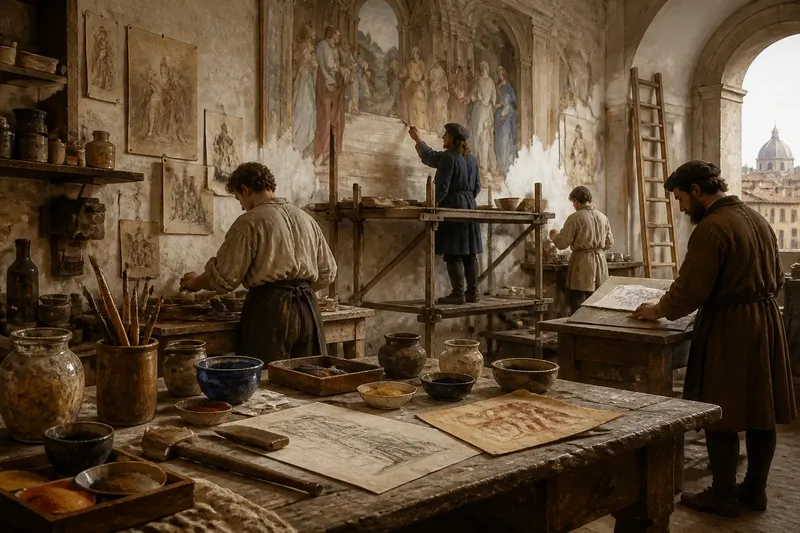
In several historical contexts, including guild-based urban trades in parts of late medieval and early modern Europe, artistic production took place in workshops shared by a master, assistants, apprentices and other workers. Here, “workshop” describes an organised place of production as much as a room. A senior artist might oversee a commission while others prepared supports, mixed colours, copied designs or completed parts of the work.
This arrangement could suit projects requiring many hands, repeated processes or different skills. Tools and materials could be kept near the work, and apprentices could learn by observing and practising tasks. They might acquire not only the handling of a brush or chisel, but also an understanding of how work was sequenced and a commission managed.
The arrangement also makes individual authorship harder to assess. A finished object might be associated with a workshop or its leading artist even when several people contributed. That is a reason to ask what the evidence supports, not to assume that every mark was made by the person whose name is best known.
When considering a work that may have involved coordinated labour, look for signs of repeated production, distinct stages or specialised preparation. These clues can prompt questions about delegation and oversight; on their own, they do not identify a particular workshop or prove who made each part.
Domestic workplaces could combine art and household life
Artists in different periods and places also worked in domestic settings: a room at home, a space used for several purposes, or an area shared with family activity. Such proximity could connect making with daily routines, but it did not mean the work was necessarily casual or solitary. Depending on the household and task, family members, servants or assistants might contribute, and visitors or patrons might enter.
A domestic space could accommodate drawing, writing or smaller objects, though the work’s scale and materials mattered. It might also support a working life closely connected with household resources or duties. A room shared for several purposes could offer less control over interruptions, storage or access than a space reserved for work.
Distinguish the location of work from the labour structure behind it. “Made at home” does not tell you whether the work was private, sold, supervised or assisted. Those questions require evidence about the particular artist, object and context.
On-site work responded to architecture and access
Some tasks had to be carried out where the finished work belonged. Murals, architectural decoration and other fixed commissions could require artists to work in a building or public setting. The workplace might be a room under construction, a prepared wall or a space temporarily adapted for production.
Working on site changed the process. Artists had to respond to the surface, dimensions and light of the location, and might need to coordinate with other workers or those responsible for the building. Tools and materials had to be brought to the work, while access could depend on the building’s use or stage of construction.
A fixed work is not simply a portable image enlarged to fit a wall. Its position, viewing distance and relationship to the room help explain how the task was organised. These details can be considered without assuming that every commission followed the same procedure.
Dedicated studios separated work from other spaces
A dedicated studio is a room, building or portion of a property set aside for artistic work. It can make it easier to leave materials in place, control access and return to an unfinished project. Depending on its size and equipment, it may also accommodate large supports or several works in progress.
Separation has consequences as well as conveniences. A studio can create a boundary between work and domestic life, while making the labour less visible to people who do not enter it. The room may present an artist as an individual maker even when assistants, suppliers, patrons or household members remain part of the work’s wider production.
The dedicated studio is one workplace arrangement among several, not a standard against which earlier settings should be judged. Its meaning depends on the period, location and work being considered.
What can each workplace reveal about making?
Why did some artists share workshops?
In contexts where commissions involved coordinated labour or apprenticeship, a shared workshop brought people, tools and materials together. It could support delegation and supervision, though the finished work might reflect contributions from several hands.
Did artists always work alone at home?
No. A domestic workplace could include family members or assistants and could support commercial as well as private work. The location alone does not show who contributed or how tasks were organised.
Why did some artists work at a commission site?
A work fixed to a building or dependent on its architecture might have to be made there. The location could shape the working sequence, access and response to the surface.
What distinguishes a dedicated studio?
A reserved workspace can keep tools and works in progress together and offer greater control over access. It can also separate artistic activity from household or public settings, changing which parts of the labour are visible.
Compare settings by the work they supported
Imagine a painter preparing a decorative scheme for a public building. The starting conditions are a fixed wall, a commission tied to that building and the need to coordinate with decorators. The painter plans the work on site, brings the necessary materials there and arranges tasks around access to the wall. The expected observable result is that the working sequence centres on the building and its surface. If the same painter instead prepares small portable pictures, a reserved studio could keep panels, tools and unfinished work together; the trade-off is that the activity is less directly organised around the building and may be less visible to others.
Use these comparisons as prompts, then decide what the evidence allows you to say:
- Shared workshop: Check for evidence of repeated tasks or multiple stages. If coordinated labour is plausible, consider delegation; if it is not, avoid assuming a team and focus on the object’s visible process.
- Domestic room: Check whether the work’s scale and materials could fit a shared household space. If they could, consider how domestic routines may have intersected with making; if not, consider whether another room or site was needed.
- Temporary site: Check whether the work is fixed to a building or responds closely to its architecture. If so, consider access and surface as part of the process; if not, do not treat an on-site workplace as necessary.
- Dedicated studio: Check whether the work involves materials or unfinished objects that benefit from remaining in place. If that is plausible, consider storage and controlled access; if not, do not assume a separate studio was required.
- Portable object: Check whether the finished work could be moved without losing its intended setting. If it could, consider a workshop or domestic room among the possibilities; if it could not, examine the site-specific context instead.
- Evidence of assistance: Check for reliable contextual information about other contributors. If it identifies assistance, include shared labour in your interpretation; if it does not, describe collaboration as a possibility rather than a fact.
These categories are not rigid. Artists could move between settings, and one project might pass through several of them. A drawing could begin at home, be developed in a workshop and become part of a commission completed on site.
Read a workplace through the object and its context
Start with clues that connect an object to labour. Is it portable or fixed to a surface? Does it appear to belong to a larger architectural scheme? Are there signs of repeated production, multiple stages or specialised preparation? Such observations can suggest what a workplace needed to support, but appearance alone cannot identify a specific room.
Then consider the social setting. A workshop raises questions about delegation and training; a household prompts questions about shared space and support; an on-site commission directs attention to architecture and coordination; a studio invites questions about privacy and control. The aim is not to invent a picturesque scene of an artist at work, but to understand how a place may have shaped choices and responsibilities.
It is not worth assigning every artwork to one perfectly documented room when the evidence does not support that certainty. A careful comparison of scale, surface and likely labour can still clarify what its setting needed to provide. Where artists worked across time becomes most revealing when place is treated as part of making’s organisation, rather than as background decoration.