The Myth of the Hidden Meaning in Every Detail
Learn how to separate what you can see in a work of art from what you infer, so interpretation stays thoughtful without turning every detail into a secret.
The most common mistake in looking at art is to treat every small feature as a code that must be cracked. The hidden meaning in every detail is a tempting idea, but it can make a careful viewer less attentive: instead of noticing what a mark, object or colour actually does, you rush to assign it a secret message.
Interpretation is not the same as decoding. A useful reading begins with what is visible, then asks what the detail might contribute and how strongly the work supports that possibility. These distinctions leave room for meaning without pretending that every feature has one fixed answer.
1. Describe before you interpret
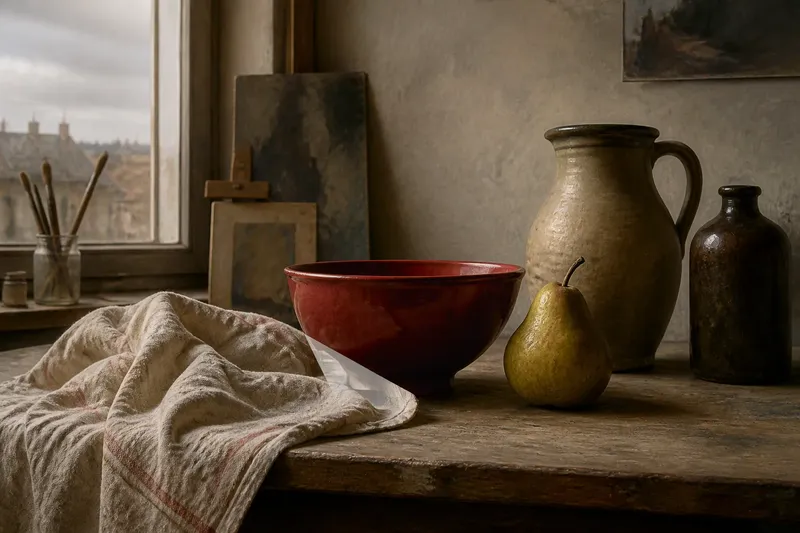
Observation records what is present without explaining why it is there. “A red bowl sits near the lower edge” is an observation. “The bowl represents danger” is an interpretation. The second statement may be worth considering, but it is not contained in the first.
Try separating the two in your notes. Write down the visible feature, its position, colour, scale, relation to nearby forms and any repeated pattern. Only then add a possible reading, marked as a possibility rather than a fact. This small pause prevents a familiar symbol from taking over before you have seen the whole arrangement.
Descriptions can be precise without becoming elaborate. If a portrait has a hand resting on a table, note its gesture, orientation and relation to the sitter’s face. Those observations give you a firmer basis for asking whether the hand suggests ease, restraint, fatigue or simply helps organise the pose.
2. Treat an interpretation as a proposal
An interpretation is a claim about how a feature contributes to a work’s meaning. Like any claim, it needs support. Support might come from a repeated motif, a strong contrast, the subject’s expression, the work’s title or the way one detail changes the effect of another.
Ask what would make your reading more convincing and what might count against it. If you read a closed door as exclusion, look for other choices that reinforce separation. If the figure beside it appears relaxed and the composition draws attention elsewhere, the door may have a more modest function. It could establish a setting or provide a block of colour.
This does not require you to prove one final answer. Art can sustain several readings. The point is to distinguish a reading grounded in visible relationships from an idea that could be attached to almost any work.
3. Notice what the detail does in the composition
A feature can matter without standing for something else. A bright patch may lead the eye; a repeated line may tie separate areas together; a small figure may make a landscape feel expansive. These are compositional effects, not necessarily symbolic messages.
Look at the work from a little farther away, then return to the detail. Does it attract attention, slow the eye, create balance or interrupt a pattern? Consider how the effect changes if you mentally cover it with your hand. If the whole arrangement feels less stable, the feature may be doing important visual work even if no secret meaning is apparent.
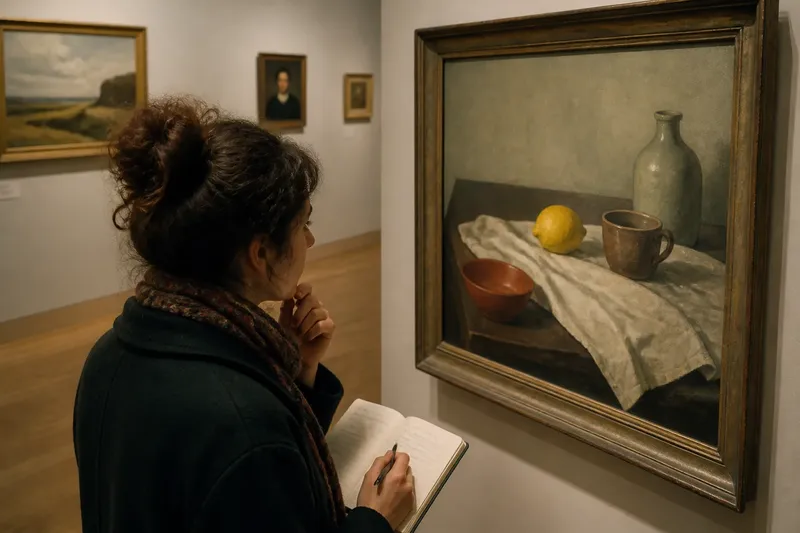
Imagine you are looking at an invented still life with a lemon, a cup and a pale patch of cloth. The lemon’s yellow may pull your eye towards one side, while the cloth carries that light colour across the table. You could explore possible associations with freshness or ripeness, but first notice how its colour helps connect the objects. That is already a meaningful artistic choice, though it is not a hidden code.
4. Separate personal association from shared evidence
A detail may remind you of a place, a memory or a symbol from your own experience. That response is real as a response, but it does not automatically tell you what the artist intended or what every viewer should see. Naming the source of the association keeps it useful rather than universal.
You might say, “The empty chair makes me think of someone absent,” rather than, “The chair means death.” The first gives an account of your reaction and leaves space for other evidence. The second turns an association into a claim about the work that may need more support.
Shared conventions can matter too. A flower, a gesture or an object may carry recognisable associations in a particular setting. But conventions shift between communities and periods, and a familiar symbol does not settle the meaning of a specific artwork by itself. Look for clues within the work before importing a ready-made explanation.
5. Ask whether repetition gives a detail weight
Repetition can make a feature seem deliberate: several similar marks, recurring objects or a colour that appears in distant parts of a composition. It can establish rhythm, direct attention or connect subjects. It may also invite symbolic interpretation, but repetition alone does not identify what a symbol means.
Compare the repeated feature with the rest of the work. Does it change each time? Is it prominent or easy to miss? Does it appear where the subject or action makes it significant? A recurring shape might echo the outlines of surrounding forms, so its purpose could be formal rather than narrative.
Be cautious about turning every recurrence into a clue. Artists repeat forms for many reasons, including visual coherence, material habit and the practical needs of a composition. A pattern supports a question; it does not answer it on its own.
6. Let uncertainty remain visible
Some works do not make a detail’s purpose clear, and that uncertainty can be part of the experience. A shadow may be hard to place, a gesture may resist a simple emotional label, or an object may have no obvious relation to the subject. You can record the uncertainty rather than filling it with a confident story.
Useful language reflects the strength of the evidence: “suggests”, “may connect”, “could draw attention to” or “I read this as”. Such phrasing is not timid. It shows where observation ends and your interpretation begins, allowing another viewer to follow your reasoning.
Nor does uncertainty mean that every reading is equally persuasive. A claim should still account for the work’s visible choices. If a proposed meaning depends on ignoring the arrangement, subject or tone, it may be less useful than a simpler reading that fits what is actually there.
7. Decide when a detail does not need an explanation
Not every feature needs symbolic weight. A painted buckle might clarify a costume; a stray mark might come from the working process; a patch of colour might help the image hold together. A detail can be noticed, described and appreciated without being assigned a hidden message.
It is not worth the effort to invent elaborate symbolism for a feature simply because it is small, unusual or easy to single out. The more productive question is whether explaining it changes your understanding of the work. If the answer is no, you can leave it as an observed feature and move on.
This restraint can sharpen attention. You may begin to see how a tiny form affects pace, balance or mood without claiming it secretly represents something. Meaning can arise through relationships and effects, not only through symbols.
How can you test a reading of a detail?
What is the difference between observation and interpretation?
Observation describes what you can see, such as an object’s colour, position or gesture. Interpretation proposes what that feature might mean or do, and should be treated as a reading rather than a visible fact.
Does an artist always intend every detail?
You cannot infer intention from a feature alone. Some choices may be deliberate, while others may arise from process, convention or practical composition; discuss what the work supports without claiming certainty about the artist’s private purpose.
Can one detail have more than one meaning?
Yes. A detail can contribute to the composition and also prompt symbolic or personal associations. The readings become more persuasive when they fit the surrounding work rather than relying on the detail in isolation.
When should you stop interpreting?
Stop when further speculation adds no support or changes nothing about your understanding. You can leave a question open and return to the larger work, where the feature’s relationships may become clearer.
Keep the evidence and the possibility together
A careful interpretation does not strip art of mystery; it makes room for mystery without confusing it with proof. Start with the visible detail, notice its effects and relationships, then offer a reading that fits those observations. When several readings remain possible, say so.
The phrase hidden meaning in every detail can prompt a useful question, but it should not become a rule. Some details carry symbolic force; others organise the image, record a material choice or simply remain unexplained. Seeing the difference lets you take both the artwork and your own response seriously.